 Plain Speaking
N-10 · Reading aloud and plain writing · written 2026-07-08
Plain writing
Written for anyone who has to produce prose other people are obliged to read.
One pass, one meaning
The working definition of plain writing is simple: a reader of ordinary attention should get the meaning on the first pass, without going back. That standard says nothing about vocabulary being small or sentences being short. It only says that the reader should never have to reconstruct a sentence in order to find out what it did.
Most prose fails this test in one of two ways. Either the sentence keeps the reader waiting for the verb while it stacks up conditions, or it uses a word whose range the reader has to guess at. Both are fixable, and both are usually invisible to the author, who already knows what the sentence says.
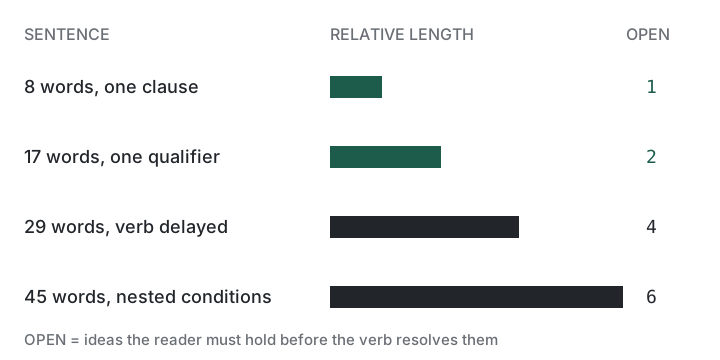
Long sentences are a symptom
Writers do not reach for a forty-word sentence because they admire long sentences. They reach for it because they have not yet decided which of the four things in it is the main one. The length is a way of avoiding the decision: everything is included, nothing is subordinated, and the reader is left to work out the hierarchy.
This is why splitting a long sentence often feels difficult. The split forces the decision that was being postponed. Once you have chosen the main clause, the rest usually resolves into a second sentence, a subordinate clause, or a thing that did not need saying at all.
Verbs, and where the action went
A great deal of institutional prose is hard because its verbs have been turned into nouns. 'Undertake an assessment of' does the work that 'assess' does, with an extra three words and a layer of distance. The habit spreads because the noun form sounds more official, and it is precisely that impression of officialness that makes the sentence tiring.
The related habit is losing the actor. Once you write 'it was determined that', the reader no longer knows who determined it, and often that is the intention. Where it is not the intention, putting the actor back in front of the verb usually shortens the sentence and clarifies it at the same time.
Order is most of the work
Sequence does more for comprehension than word choice. A paragraph that begins with its conclusion and then supports it is easier than one that assembles evidence and reveals the conclusion at the end, because the reader knows where to put each piece as it arrives.
The same applies inside the sentence. Put the familiar thing first and the new thing last, and consecutive sentences will link themselves: the new item at the end of one sentence becomes the familiar item at the start of the next. Prose that does this feels effortless, and readers never notice why.
Editing by ear
The cheapest editing method available is to read the draft aloud. Every place you stumble is a place the reader will slow down, and you will find them at speaking pace without needing any theory about why they are difficult. This is the same test described in the note on reading aloud, applied in the other direction.
Cut in two passes. In the first, delete whole sentences that do not carry an idea. In the second, shorten what remains. Doing both at once produces prose that is uniformly compressed and still contains everything, which is harder to read than a longer draft with the dead paragraphs removed.