 Plain Speaking
N-08 · Listening and conversation · written 2026-06-11
Listening well
Written for anyone who has ever left a conversation realising they heard none of it.
Listening is a turn, not a pause
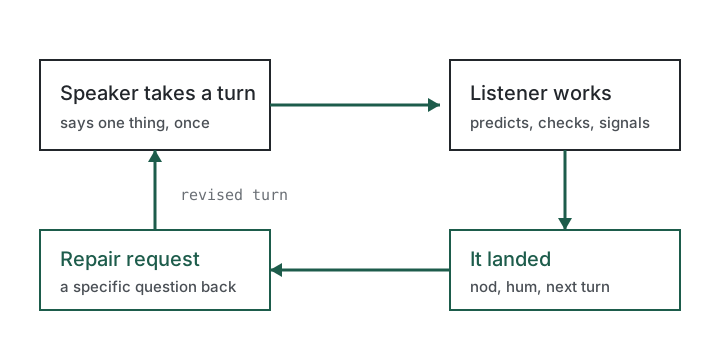
The common model of conversation has one person transmitting while the other waits. That model is wrong in a way that causes real damage, because it treats the listener's job as passive. In practice the listener is continuously working: predicting where the sentence is going, deciding whether it has landed, and producing a stream of small signals that tell the speaker whether to continue or to back up.
Those signals are tiny and constant. A nod, a hum, a change of expression, a half-second of held eye contact. Take them away and the speaker falters within a sentence or two, which is why talking to a silent, motionless listener is so unpleasant and why phone calls feel more effortful than they should.
What attention actually costs
Following someone properly consumes most of the capacity you have available. This is why it is genuinely impossible to listen closely while composing your reply, and why the person who is visibly waiting to speak has usually stopped hearing you a sentence ago. The reply they eventually give will answer the thing you said at the point where they stopped listening.
The practical consequence is unglamorous: if you want to listen well, give up the reply. Let it be assembled after the other person has finished, in the second of silence that most people find unbearable and rush to fill. That silence is where the good replies come from.
Repair is the useful signal
Conversations are full of repair. People restart sentences, substitute a clearer word, ask 'sorry, do you mean the second one?', and re-explain something from a different angle. Repair is not a sign that a conversation is going badly; a conversation with no repair in it is usually one where one party has quietly given up on understanding.
The most valuable single move available to a listener is the specific question. 'Can you say more about that' is weak. 'When you say the deadline moved, do you mean the delivery date or the review?' is strong, because it exposes exactly which part failed to arrive and lets the speaker fix that part rather than repeating the whole thing.
Summarising back
The other reliable move is to say the thing back in your own words. Not as a courtesy but as a test: if you cannot reconstruct it, you did not have it. Doing this out loud gives the speaker a chance to correct the reconstruction while it is still cheap to correct.
It has to be your own words. Repeating someone's sentence back verbatim demonstrates that your ears worked, which was never in doubt. Rebuilding the point from scratch demonstrates that it arrived, which is the thing at issue.
Listening in a room of six
Group conversation breaks the mechanics. The gaps are shorter, the competition for them is higher, and the people who are best at claiming them are not reliably the people with the most to say. Anyone who needs a moment to assemble a thought is structurally disadvantaged, and the room loses the contribution without ever noticing it was available.
Whoever is chairing can fix most of this cheaply by naming the gap: pausing deliberately, asking a specific person a specific question, and refusing to let the fastest talker set the tempo. It is a small intervention that changes what a meeting is able to hear.